Mobile apps

Mobile apps for stores, services and delivery, on Android and iOS.

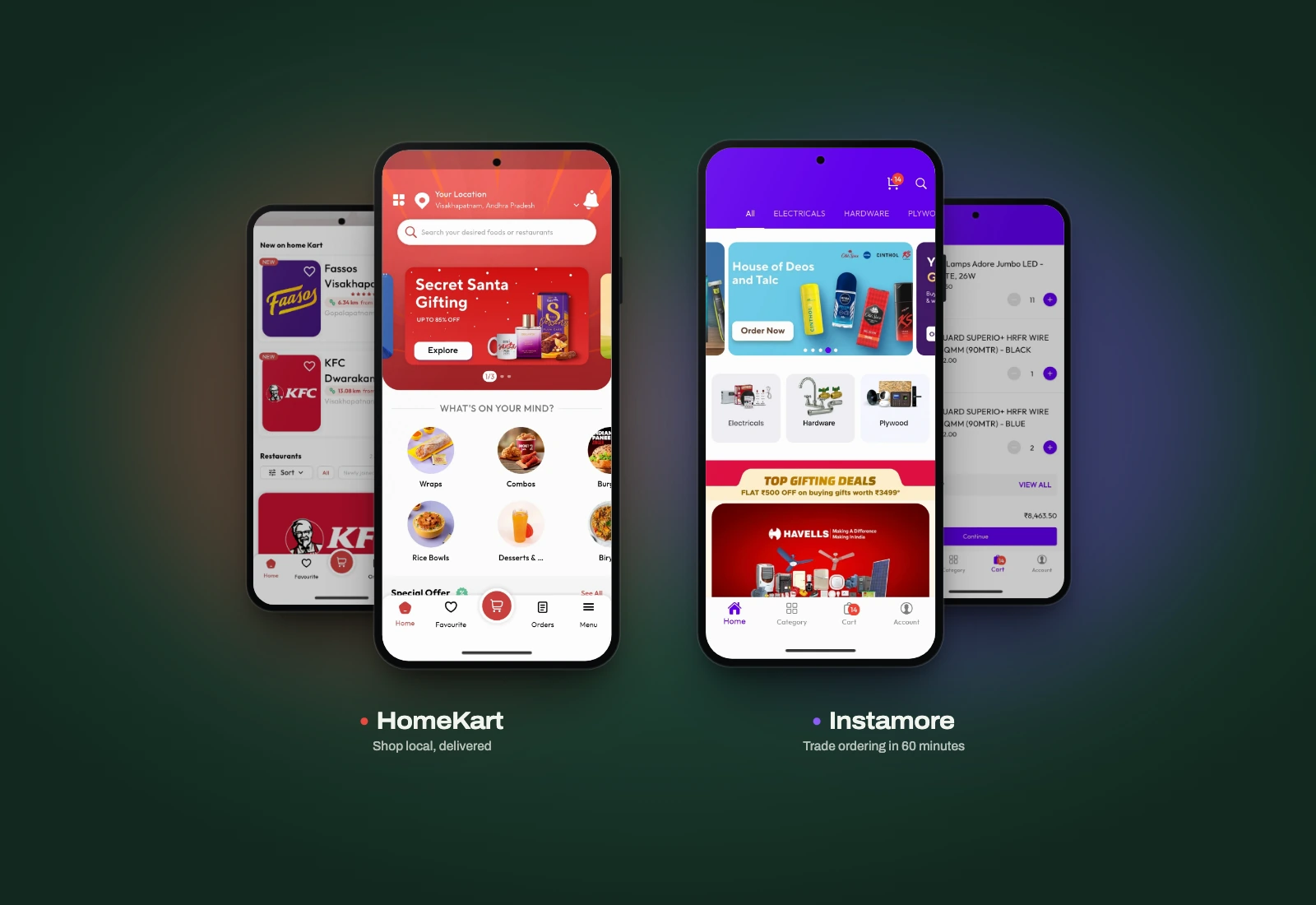
An app is rarely one app. A shopping experience needs a rider app, a store app and an admin panel that all agree with each other, or the orders stop making sense by the second week. We design and build the whole system, take it through Play Store and App Store review, and stay for the updates that follow. Two of ours are live on Google Play today, which means we have dealt with the review rejections and the OS upgrades, not just the happy path.

Discuss your project

What you can expect

  • Customer, operations and admin apps that share one source of truth
  • Published and maintained on Google Play and the App Store, under your own developer account
  • Real-time order status that customers and staff can both rely on
  • An app that still works on a four-year-old Android phone and a weak connection

Every way an app can be built

We choose the approach by what your app has to do, not by what is fashionable. Here is when each one is the right call.

Native Android

Built directly for Android in Kotlin. The right call for background location, Bluetooth, printers, heavy camera work, and apps used on low-end phones over patchy networks.

Right whenThe app depends on hardware or background behaviour, or nearly all your users are on Android.

Native iOS

Built directly for iPhone and iPad in Swift, with the smoothest animation and the deepest Apple integrations such as Apple Pay, widgets and notifications.

Right whenYour customers are mostly on iPhone, or you need Apple-only features.

Flutter

One codebase for both stores, near-native speed and an interface that looks the same on every phone. Our default for commerce, delivery and booking apps.

Right whenYou want Android and iOS together, on one budget, without a compromised feel.

React Native

JavaScript and TypeScript apps that share people, logic and code with your web team. A strong fit when you already run a React site or web app.

Right whenYour web platform is React and you want one team and shared logic across both.

Hybrid and PWA

Web technology packaged for the stores with Capacitor, or a progressive web app that installs from the browser with no store at all. Quick to ship and lighter on cost.

Right whenYou need something live quickly, the app is mostly content or forms, or you want to test demand first.

The system behind the app

APIs, admin dashboards, notification infrastructure and role-based access, so a small back office can run a large catalogue, thousands of orders and a fleet of delivery staff.

Right whenAlways. An app without a good back office becomes a burden by the second month.
Our specialty

Shopify and WooCommerce stores, turned into mobile apps.

If you already sell online, an app is the quickest way to lift repeat orders. Your store stays the source of truth for products, prices, stock and orders, and the app adds what a mobile site cannot: push notifications, saved carts, one-tap reordering and an icon on your customer’s home screen.

  • A catalogue that stays in sync

    Products, variants, prices and stock come straight from your store, so nothing is entered twice.

  • Checkout that converts

    Razorpay, Stripe, UPI and cash on delivery, with saved addresses and one-tap reorder.

  • Push and win-back

    Order updates, abandoned-cart reminders, back-in-stock alerts and offers that reach the lock screen.

  • Loyalty and offers

    Coupons, wallets, referral rewards and app-only prices that give people a reason to install.

  • Delivery and operations

    Rider apps, live tracking, store and partner apps, and an admin panel for fulfilment.

  • Store publishing handled

    Listing, screenshots, privacy forms, review submissions and rejections, all under your own developer accounts.

What we connect

What apps we build plug into. If your system has an API or an export, the app can talk to it.

Commerce backends

  • Shopify
  • WooCommerce
  • Magento
  • Custom catalogue APIs
  • ERP and inventory systems
  • Zoho Inventory

Payments

  • Razorpay
  • Stripe
  • PayU
  • Cashfree
  • UPI apps
  • Apple Pay and Google Pay
  • Cash on delivery reconciliation

Messaging and engagement

  • Firebase Cloud Messaging
  • OneSignal
  • WhatsApp Business API
  • Twilio
  • MSG91 for SMS and OTP
  • In-app offers and referrals

Maps and delivery

  • Google Maps
  • Live location tracking
  • Shiprocket
  • Delhivery
  • Barcode and QR scanning

Accounts and CRM

  • QuickBooks
  • Zoho Books
  • Tally exports
  • HubSpot
  • Zoho CRM

Analytics and quality

  • Firebase Analytics
  • Crashlytics
  • Mixpanel
  • Meta and Google Ads tracking
  • Performance monitoring

What we build

Customer apps

Catalogues, search, carts, payments, order tracking, reorder and offers, designed around how your buyers actually shop rather than how your catalogue happens to be organised.

Rider and delivery apps

Assignment, route and status updates, proof of delivery, cash and digital collection reconciliation, and a location approach that does not flatten the phone battery by lunchtime.

Store, vendor and partner apps

Order acceptance, stock and price updates, payout visibility and performance figures, so the businesses selling through you can run themselves instead of phoning your team.

Admin panels and dashboards

Catalogue and pricing control, order management, refunds, promotions, user roles and reporting, built for the people who use it all day rather than for a demo.

Store launch and maintenance

Listing copy, screenshots, privacy declarations, data safety forms, review submissions and the follow-up when a submission is rejected, then OS updates, crash monitoring and new features.

Recent builds

Tools we use

Questions

Do you build for both Android and iOS?

Yes. Most projects use a cross-platform approach so both apps share one codebase, which lowers cost and keeps features in sync. We go native for the parts that genuinely need it, such as continuous background location or receipt printing.

Can you turn our Shopify or WooCommerce store into an app?

Yes, and it is often the fastest route to a real app. The store stays your source of truth for products, prices, stock and orders, while the app adds push notifications, faster repeat ordering and a checkout built for thumbs. You are not maintaining two catalogues.

Can you publish the app on the Play Store and App Store?

Yes. We prepare the listing, screenshots, privacy policy and data safety declarations, submit for review and handle rejections when they come, which they sometimes do. Everything is published under your own developer account so you keep full ownership.

How much does a mobile app cost?

It depends almost entirely on how many kinds of user you have. A single customer app with a catalogue and payments is a much smaller project than a system with customer, rider, vendor and admin apps. We scope it in phases and tell you what can wait until version two.

What happens after launch?

Apps need maintenance in a way websites do not: Android and iOS release yearly updates that can break things, and stores change their rules. Monthly support covers OS updates, crash monitoring, store compliance, bug fixes and new features.

Do we own the code?

Yes. The repository, the developer accounts, the API keys and the app itself are yours. If you bring another team in later, they get a clean handover rather than a puzzle.